HeLa Citizen ID, Explained: Blockchain Identity Without the Crypto Headache
Seed phrases and wallet extensions keep most people out of Web3. HeLa Citizen ID takes a different approach — your identity lives on-chain, but you unlock it with your face or fingerprint, the same way you unlock your phone.
The Problem With Web3 Identity
Ask someone who has never used crypto to "set up a wallet," and you'll immediately understand why mainstream adoption is stuck.
The standard flow requires them to:
- Install a browser extension
- Write down 12 random words and store them somewhere safe, forever
- Buy cryptocurrency to pay for gas before they can do anything
- Navigate an address like
0x742d35Cc…without ever making a typo
Lose those 12 words? Everything is gone. Share them by accident? Same result. There is no customer support, no password reset, no way back.
Web3 built the most powerful ownership primitive in computing history, then wrapped it in one of the worst user experiences ever designed.
HeLa Citizen ID is built to change that.
What Is a Citizen ID?
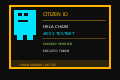
A Citizen ID is an on-chain identity — a verifiable, permanent record on HeLa Chain that represents you.
Think of it like a passport, but instead of sitting in a government database that you cannot directly control, your identity lives in a smart contract that only you can authorize.
Each Citizen ID is:
- Unique — one per person, issued through a verified process
- Yours — stored in a contract account you control, not a company's server
- Programmable — your identity account can hold assets and interact with other contracts on your behalf, using ERC-6551 Token Bound Accounts
- Free to mint — gas is sponsored through a relay network; you do not need to own any cryptocurrency to get started
How It Works
Here is the flow when you mint a Citizen ID, without the technical jargon.
Step 1 — You prove you're you. No browser extension, no seed phrase. You authenticate the same way you unlock your phone — with a fingerprint or Face ID. This uses a FIDO2/WebAuthn passkey, the same open standard that Apple, Google, and most major banks already use for secure sign-in.
Step 2 — HeLa verifies the passkey on-chain. Your phone's passkey generates a cryptographic signature using the P-256 curve — the same curve used inside Apple Secure Enclave and Android Keystore. HeLa Chain's EIP-7951 precompile verifies that signature natively on-chain at 3,450 gas, compared to roughly 300,000 gas on a standard EVM chain. That is approximately an 87× reduction in verification cost.
Step 3 — Your Citizen ID is minted gaslessly. A relay network submits the mint transaction on your behalf, using ERC-4337 Account Abstraction. You pay nothing. The transaction is signed, verified, and recorded on-chain permanently — the first Citizen ID was minted on HeLa testnet in April 2026 using exactly this flow.
Step 4 — You own a programmable account. Your Citizen ID is not just a badge. It is a smart contract account that persists on-chain indefinitely, regardless of what happens to any app or service built on top of it. It can hold tokens, interact with HeLa dApps, and authorize AI agents to act on your behalf.
What You Actually Experience
From a user perspective:
- Open HelaSyn or another HeLa app
- Tap "Continue with Face ID" (or fingerprint)
- Your phone's biometric prompt appears — same as unlocking your phone
- You're in
No wallet extension. No seed phrase. No gas payment. No hex addresses to copy and paste.
The cryptography, the on-chain verification, and the relay transaction all happen invisibly. You never touch a private key.
Current Status
HeLa Citizen ID is live on testnet (chain ID 666888). Mainnet activation follows final engineering polish.
What is coming next: passkey authentication is being wired directly into the HelaSyn onboarding flow, so getting a Citizen ID becomes the first step every new user takes — not an advanced feature for developers to test.
Why This Matters
Most Web3 identity projects talk about decentralization in the abstract. HeLa Citizen ID is built around a specific, concrete problem: regular people cannot use Web3 because the key management is too hard, and the cost of a single mistake is total and permanent loss.
The P-256 passkey stack, gasless relay, and ERC-6551 programmable accounts are not separate features — they are a coordinated stack designed to make on-chain identity feel like signing into any modern app.
If you have ever unlocked your phone with your face, you already know how to use HeLa Citizen ID.