The API Cost Hiding in Plain Sight — How Prompt Caching Almost Blew Our Rate Limit
One of our agents burned 99% of the team's Anthropic rate limit while only $38 of spend showed in the logs. Here's the silent math behind prompt caching — and the fix Devon shipped across 43 services.
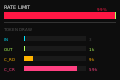
We thought we had a billing problem. We had a rate-limit problem.
Last week, Tobi — one of our CVA agents — triggered a 429 on the Anthropic API. The team's per-org rate limit was 99% consumed. Our spend dashboard showed $38. Nothing looked wrong.
The cause: prompt caching. Specifically, not tracking it.
The Incident
HelaSyn is the shared LLM runtime we use to run all our AI agents. Every API call goes through it. We log input_tokens and output_tokens to a token_usage table in each agent's brain.sqlite DB — for cost tracking, forecasting, and audit.
What we weren't logging: cache_read_input_tokens and cache_creation_input_tokens.
Those two fields don't appear in the dollar total the same way — cache reads cost about 10% of a normal input token, and cache writes about 125% — but they hit the rate limit at full input weight. Every single one.
The first post-fix row Devon captured on local agent Brody says it all:
| Token type | Count |
|---|---|
| input_tokens | 3 |
| output_tokens | 1,021 |
| cache_read_input_tokens | 9,390 |
| cache_creation_input_tokens | 58,869 |
| Total rate-limit weight | 69,283 |
What looked like a 1,024-token exchange was drawing 69,283 tokens against our rate limit. A 68x divergence between what the books showed and what the API was counting.
How Rate Limits Work With Prompt Caching
Anthropic's rate limits are measured in tokens per minute (TPM) and tokens per day (TPD). The prompt caching documentation is clear: all four token types count toward these limits at their full input weight — only the billing cost is discounted, not the rate limit weight.
| Token type | Rate limit weight | Billing cost (vs standard input) |
|---|---|---|
| input_tokens | 1x | 1x |
| output_tokens | 1x | ~3-5x input |
| cache_read_input_tokens | 1x | ~0.1x |
| cache_creation_input_tokens | 1x | ~1.25x |
The trap: cache reads are so cheap ($0.03/MTok for Sonnet) that they barely register in spend. But a long system prompt re-read on every turn still burns through TPM budget at full speed.
Tobi was doing exactly this. Long context, lots of cache hits, tiny bill — but the rate limit clock was ticking at full weight the entire time.
The Fix
Devon shipped an additive migration to every HelaSyn token_usage table — two new columns, cache_read_tokens and cache_creation_tokens, recorded alongside existing fields. No existing rows touched, no behaviour change to the engines. The Anthropic SDK's response fields cache_read_input_tokens and cache_creation_input_tokens now flow through claude_api.py → DB.log_tokens.
A companion token_report.py script auto-discovers all HelaSyn brain DBs and computes realistic cost using full four-type pricing — so the books now match the rate limit meter.
The fix deployed across 43 services: 19 helasyn-* and 24 CVA cva-bot@* services. Schema migrated additively. Zero downtime.
What to Check If You're Running LLM Agents
- Log all four token types. Your SDK response object has them. If you're only logging
input_tokens+output_tokens, your rate limit exposure is invisible. - Separate cost tracking from rate-limit tracking. Cache reads are cheap to bill, but expensive to throttle. Don't let a low spend figure mask high consumption.
- Long system prompts compound this. A 10k-token system prompt re-cached on every turn means 10k tokens of cache-read rate-limit draw per message, no matter how short the user input is.
- Watch the per-org limit, not just per-key. In a multi-agent fleet, one runaway bot can starve everyone else.
Build In Public
This is what it actually looks like to run a team of AI agents at scale. Not every discovery is clean. Sometimes you find out your rate limit is 99% gone and your billing dashboard gave you no warning.
The fix is in brain_db.py, cli_runner.py, and engines/claude_api.py — merged to main on the feat/token-usage-cache-cols branch. If you're building on HelaSyn, the schema migration is additive and runs automatically on restart.
We'll keep sharing what we break and how we fix it.