EIP-7951 P-256 Precompile — Mainnet Upgrade Technical Brief
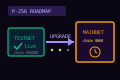
HeLa is preparing to activate the EIP-7951 P-256 signature verification precompile on mainnet (Chain ID 8668). This post covers what the upgrade includes, how it was validated, and what developers should expect.
Upgrade Summary
| Detail | Value |
|---|---|
| Feature | Native P-256 (secp256r1) ECDSA signature verification |
| Specification | EIP-7951 (security-hardened RIP-7212) |
| Precompile address | 0x0000000000000000000000000000000000000100 |
| Gas cost | 3,450 (fixed) |
| Testnet status | LIVE since April 15 (Chain ID 666888) |
| Mainnet status | Pending governance vote |
| Activation method | On-chain governance — runtime upgrade at designated epoch |
Why P-256
P-256 (also known as secp256r1 or prime256v1) is the curve used by virtually all modern authentication hardware:
- Apple — Face ID, Touch ID (Secure Enclave)
- Android — Fingerprint, face unlock (StrongBox / TEE)
- Windows — Windows Hello (TPM 2.0)
- FIDO2/WebAuthn — Hardware security keys (YubiKey, Titan)
- Banking — HSMs, smart cards, payment terminals
- TLS — Default curve for HTTPS certificate signatures
Ethereum's native curve is secp256k1. Verifying a P-256 signature in pure Solidity requires on-chain elliptic curve arithmetic — approximately 300,000 gas per verification. The precompile reduces this to 3,450 gas, an 87x reduction.
This makes passkey-based smart account wallets economically viable on HeLa.
Specification: EIP-7951 vs RIP-7212
RIP-7212 is the widely adopted P-256 precompile standard, live on Polygon, Optimism, Arbitrum, Base, zkSync, and Scroll. Shipped to Ethereum L1 in the Fusaka upgrade (December 2025) as EIP-7951 at 6,900 gas — the security-hardened successor to RIP-7212.
HeLa runs EIP-7951's validation logic at RIP-7212's 3,450 gas pricing. The validation differences are additional input-correctness checks:
| Validation Check | RIP-7212 | EIP-7951 (HeLa) |
|---|---|---|
| Input length ≠ 160 bytes | Returns empty | Returns empty |
| r = 0 or s = 0 | Not enforced | Rejected |
| r ≥ n or s ≥ n (curve order) | Not enforced | Rejected |
| Point-at-infinity on recovered point R' | Not checked | Rejected |
Modular comparison r' ≡ r (mod n) | Plain equality | Modular |
| Public key not on curve | Rejected | Rejected |
HeLa's implementation runs EIP-7951's validation logic at RIP-7212's gas pricing (3,450 gas). Ethereum L1 priced the same logic at 6,900 gas in Fusaka based on different benchmarking. Source for HeLa's gas constant: oasis-sdk/runtime-sdk/modules/evm/src/precompile/p256verify.rs.
These additional checks prevent edge-case signature malleability and invalid-key attacks. While unlikely in normal usage, a precompile is permanent infrastructure — it will be called by smart account validators, credential verifiers, and token-gating contracts across HeLa's lifetime. The stricter validation is the correct default.
Interface
Input: 160 bytes, packed (no ABI encoding):
| Offset | Field | Size | Description |
|---|---|---|---|
| 0 | msg_hash | 32 bytes | SHA-256 hash of the signed message |
| 32 | r | 32 bytes | ECDSA signature r component (big-endian) |
| 64 | s | 32 bytes | ECDSA signature s component (big-endian) |
| 96 | x | 32 bytes | Public key X coordinate (big-endian) |
| 128 | y | 32 bytes | Public key Y coordinate (big-endian) |
Output:
- Valid signature:
0x0000000000000000000000000000000000000000000000000000000000000001(32 bytes) - Invalid signature: empty bytes (0 bytes)
- Out of gas (< 3,450): execution reverts
Solidity usage:
address constant P256_VERIFIER = address(0x100);

function verifyP256(
    bytes32 msgHash,
    bytes32 r, bytes32 s,
    bytes32 pubX, bytes32 pubY
) internal view returns (bool) {
    (bool success, bytes memory result) = P256_VERIFIER.staticcall(
        abi.encodePacked(msgHash, r, s, pubX, pubY)
    );
    return success
        && result.length == 32
        && abi.decode(result, (uint256)) == 1;
}
Important: HeLa mainnet runs London EVM (pre-Shanghai). Compile Solidity with
--evm-version london. Opcodes PUSH0, MCOPY, TLOAD/TSTORE are not available.
Implementation
- Language: Rust
- Cryptography: RustCrypto
p256crate v0.10.1, audited by zkSecurity (April 2025) - Location:
oasis-sdk/runtime-sdk/modules/evm/src/precompile/p256verify.rs(~280 lines) - Unit tests: 8 tests covering all input validation branches
The implementation deserializes the 160-byte input, checks all EIP-7951 validation rules, and delegates to the audited p256::ecdsa::VerifyingKey::verify_prehash function. No custom cryptographic math.
Security Audit
Seth (HeLa AI Security Agent) audited the implementation before testnet activation.
| Severity | Count | Details |
|---|---|---|
| Critical | 0 | — |
| High | 0 | — |
| Medium | 1 | Gas cost constant alignment with final EIP-7951 spec (tracked) |
| Low | 3 | PrehashedDigest type migration, additional unit test coverage, documentation |
| Informational | 10 | Style, naming, comments |
Verdict: GO-WITH-FIXES for testnet. No blockers for mainnet.
The three low/medium items are tracked for follow-up and do not affect correctness or security of the precompile.
Testnet Validation
The precompile was validated in three stages:
Stage 1: Devnet (April 10–15)
Quan deployed to a dedicated devnet node at 54.251.196.3:3000. Devon's test harness ran 8 tests covering:
- Valid P-256 signature → returns
0x00...01 - Wrong message hash → returns empty
- r = 0 → returns empty
- s = 0 → returns empty
- r ≥ curve order → returns empty
- Wrong input length (100 bytes) → returns empty
- Off-curve public key → returns empty
- Out-of-gas (3,000 < 3,450) → reverts
Result: 8/8 passed.
Stage 2: Testnet Governance Activation (April 15)
Quan activated the precompile on the public testnet (Chain ID 666888) via on-chain governance vote. All 8 testnet nodes (4 compute + 4 RPC) upgraded automatically at the designated epoch.
Stage 3: Public Testnet Verification (April 16)
The same 8-test suite was re-run against the public testnet RPC (https://testnet-rpc.helachain.com):
| # | Test | Expected | Actual | Gas | Result |
|---|---|---|---|---|---|
| 1 | Valid signature | valid(1) | valid(1) | 211,468 | PASS |
| 2 | Invalid message | invalid(empty) | invalid(empty) | 211,468 | PASS |
| 3 | r = 0 | invalid(empty) | invalid(empty) | 211,468 | PASS |
| 4 | s = 0 | invalid(empty) | invalid(empty) | 211,468 | PASS |
| 5 | r ≥ n | invalid(empty) | invalid(empty) | 211,468 | PASS |
| 6 | Wrong length | invalid(empty) | invalid(empty) | 211,408 | PASS |
| 7 | Bad pubkey | invalid(empty) | invalid(empty) | 211,468 | PASS |
| 8 | Out of gas | revert/OOG | revert/OOG | 3,000 (cap) | PASS |
Result: 8/8 passed on public testnet. Block 956,760.
Gas estimate of ~211K includes the 21,000 base transaction cost + calldata overhead. The precompile's intrinsic cost of 3,450 is within this total.
Mainnet Deployment Process
The upgrade follows HeLa's standard runtime upgrade process:
- Build — Quan compiles the new runtime binary (.orc) using the official builder toolchain
- Upload — Binary and web3 gateway uploaded to the mainnet deployment server
- Register — New runtime version registered on-chain with a target epoch (current + 2 minimum)
- Governance vote — Validator owners vote to approve the upgrade
- Auto-activation — All nodes switch to the new runtime at the designated epoch
- Verification — 8-test suite re-run against mainnet RPC + scanner health check
No manual node restarts required. No downtime. The chain continues producing blocks throughout.
What This Enables
With P-256 verification at 3,450 gas, the following become practical on HeLa:
Passkey Smart Accounts (ERC-4337) Users create a wallet with Face ID or Touch ID. The phone's Secure Enclave generates a P-256 key pair. Every transaction is signed biometrically. No seed phrase, no browser extension.
Gasless Citizen Onboarding HeLa's Citizen ID onboarding uses ERC-4337 with a Paymaster for sponsored gas. P-256 precompile reduces per-signup verification cost from ~0.09 HLUSD to ~0.035 HLUSD — making Paymaster-subsidized onboarding sustainable at scale.
WebAuthn On-Chain Any protocol needing FIDO2 authenticator verification — login, credential issuance, identity verification — can now do it natively in Solidity without an off-chain oracle.
HSM and Banking Integration P-256 is the standard curve for hardware security modules, smart cards, and banking infrastructure. On-chain verification of HSM-signed data becomes economically viable.
For Developers
Try it now on testnet:
- Chain ID:
666888 - RPC:
https://testnet-rpc.helachain.com - Precompile:
0x0000000000000000000000000000000000000100 - Solidity: compile with
--evm-version london
After mainnet activation:
- Chain ID:
8668 - RPC:
https://mainnet-rpc.helachain.com - Same precompile address and interface
The precompile is fully compatible with existing RIP-7212 tooling and libraries (e.g., Daimo's P256Verifier.sol, Coinbase Smart Wallet's WebAuthn verifier). Code written for RIP-7212 on other chains works on HeLa without modification.
Credits
- Quan — Implementation and builder deployment
- Devon — Devnet test harness and on-chain validation
- Seth — Security audit
- KC / Max — Coordination and sign-off
Full technical documentation: P256 Precompile Tech Doc. Test the precompile on HeLa Testnet. Questions or integration support: reach out to the HeLa AI team.